


Internationale Keyword Research: Global SEO Strategy Guide
Internationale Keyword Research: Global SEO Strategy Guide
Why Internationale Keyword Research Matters for Global Brands
Expanding into international markets without local keyword research wastes content investment and misses revenue. Brands that translate their domestic keyword list and publish across country sites lose visibility because search behavior is cultural, not linguistic. A UK term like “jumper” means nothing to US shoppers searching for “sweater.” A French consumer looks for “café en grains” not a literal translation of “coffee beans.” Search engines reward locally relevant content and ignore translated replicas¹.
What Happens When Brands Skip Local Keyword Research?
Content built on translated keywords ranks poorly and drives near-zero traffic. One B2B software company discovered that the German keyword they targeted for eight months—translated directly from their English top-performer—had 94% less search volume than the actual term German professionals use. The investment in content and paid campaigns delivered almost nothing¹.
Beyond wasted effort, missed opportunities compound. Competitors who invest in local keyword research capture the traffic. Over time, they build local authority that becomes increasingly expensive to challenge. The gap widens with every quarter of inaction².

How Is International Keyword Research Different From Domestic SEO?
Four dimensions separate international from domestic keyword research. Each must be accounted for per target market.
| Dimension | Domestic SEO | International SEO |
|---|---|---|
| Language | Single language | Same language varies by country: Spanish (Spain) ≠ Spanish (Mexico) |
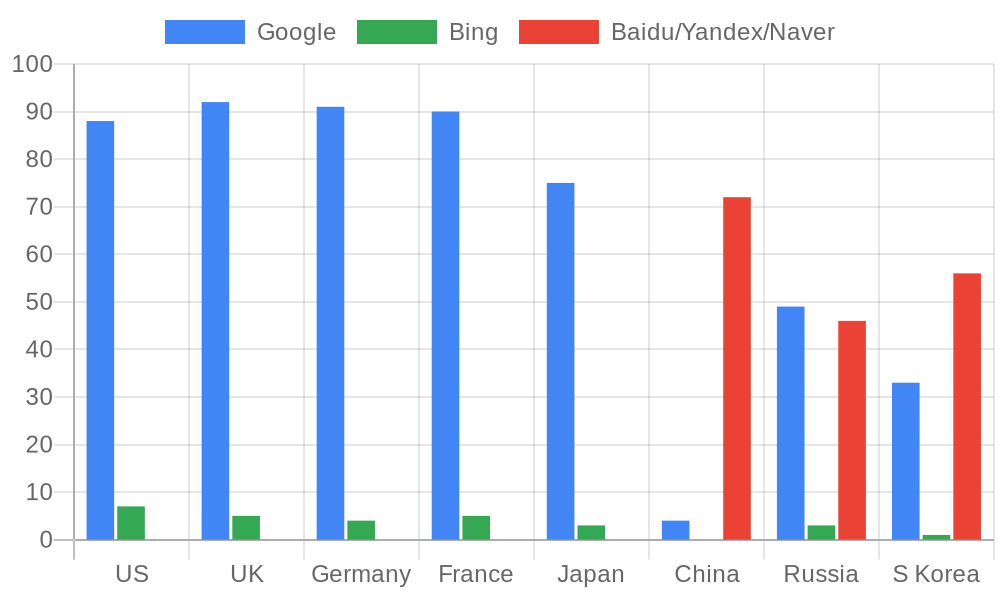
| Search Engine | Google only | Baidu (China), Yandex (Russia), Naver (S Korea) dominate locally |
| Intent | Uniform per market | “Football” = soccer (UK) vs American football (US) |
| Culture | Single cultural context | Holidays, buying patterns, social norms vary by country |
Ignoring any dimension means building content for the wrong audience through the wrong channel with the wrong terminology².
How International SEO Keyword Research Works
International keyword research follows a six-step framework that scales across any number of countries. The process starts with market definition and ends with ongoing measurement. Every step requires local data—assumptions made in one country rarely transfer to another¹.
What Are the Six Steps of International Keyword Research?
- Define target countries, languages, and buyer personas — Identify priority markets based on demand, competition, and operational capacity
- Build seed keywords in your source language — Do not translate yet; these are conceptual anchors
- Expand keywords using localized tools — Country-specific data from Google Keyword Planner, Ahrefs, or SEMrush
- Analyze local SERPs to decode intent — What content formats rank? Informational or commercial?
- Create a keyword-to-URL map — Prevent cannibalization with correct hreflang implementation
- Implement localization and track per country — Region-specific content, not cloned pages
How Do You Define Target Countries and Languages?
Most brands target too broadly. “Europe” is not a market. Switzerland requires content in German, French, and Italian. Canada demands English and French variants. Spanish varies between Spain, Mexico, and Argentina—each uses different vocabulary for identical products¹.
Determine which languages people actually search in within each country. In Belgium, consumers search in Dutch, French, and German. Prioritizing countries based on current revenue, search volume potential, and competitive landscape prevents resource dilution across unviable markets².
How Do You Expand Keywords Using Localized Tools?
Enter seed keywords into country-specific research tools. Google Keyword Planner reveals actual local search volumes when you change location and language settings. The results surface region-specific phrasing that no translator would produce. A coffee brand targeting France discovers that “café pour machine espresso” has significant volume—a phrase no literal translation of “espresso machine coffee” would generate¹.
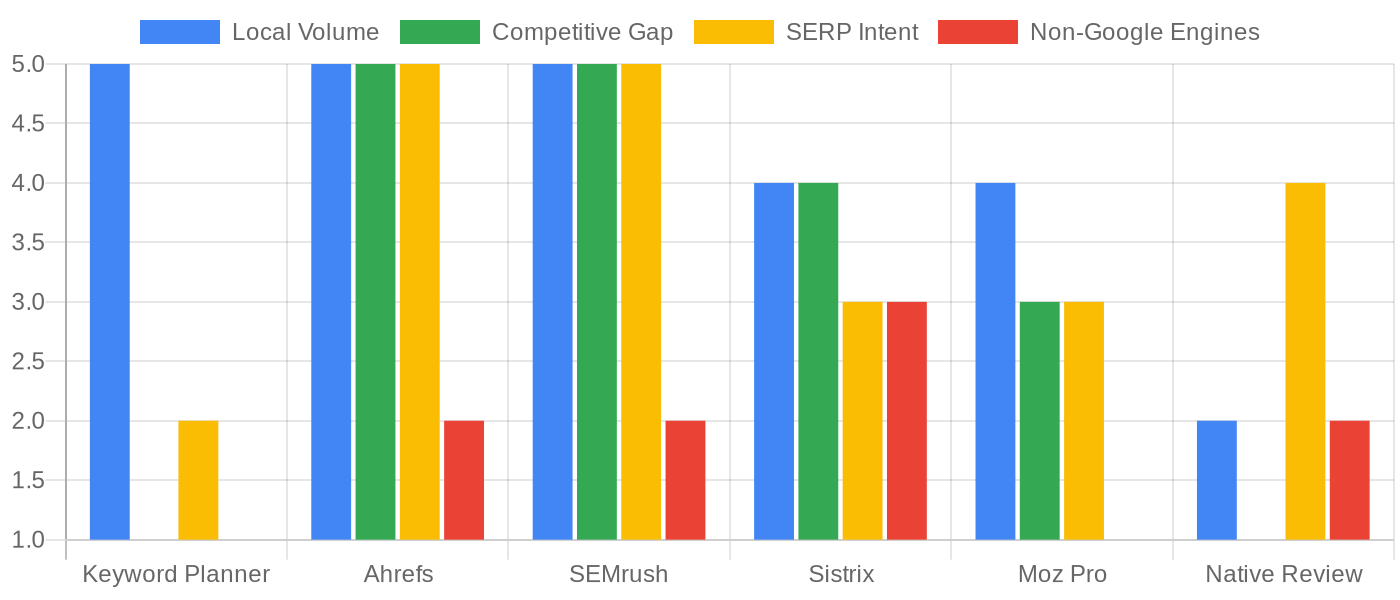
Ahrefs and SEMrush add competitive depth: which local competitors rank for which terms, keyword difficulty by country, and cost-per-click signals for commercial intent. These tools also support international gap analysis—comparing your keyword coverage against local competitors to find quick-win opportunities where you have no presence³.
How to Conduct International Keyword Search
The tool landscape for international keyword search has matured, but effectiveness depends on matching the right tool to the right task. No single platform covers every market fully—a multi-tool approach is standard practice for brands operating across more than two or three countries³.
What Tools Work Best for International Keyword Discovery?
- Google Keyword Planner — Free, baseline regional search volumes, answers the essential question: does anyone in this country search for what we sell?
- Ahrefs / SEMrush — Country-specific keyword databases, competitive gap analysis, keyword difficulty by region, CPC signals for commercial intent
- Sistrix — Strong European market coverage, visibility index by country, useful for DACH and Western European markets
- Native speaker validation — No tool replaces a local expert reviewing keyword lists for cultural relevance, intent accuracy, and missing variants
For non-Google search engines, specialized tools are necessary. Baidu Keyword Planner operates on different principles than Google’s tool. Yandex Wordstat provides Russian-language data inaccessible through Google platforms. Naver’s keyword ecosystem reflects its blog-and-café content structure. Entering these markets without native keyword tools means competing blind².
How Do You Analyze Local SERP Data?
Never assume intent without checking what actually ranks. The top results for a keyword in Germany might be informational blog posts while the same keyword in the US shows e-commerce category pages. Check SERP features: local results include FAQ accordions, shopping carousels, or local packs that dictate content format requirements¹.
Use Ahrefs SERP overview or a VPN-based manual search to see what local users see. If dominant results are listicles and comparison guides, a product page will struggle. If SERP features include video carousels, YouTube content becomes essential. Match the format the search engine already validates for that market³.
How Keywords Rank Across International Markets
Keyword rankings do not transfer across borders. A domain can hold position three for a keyword in the United States and position 47 for the same keyword in the United Kingdom—even with identical content. Search engines maintain independent indexes per country, and each operates on its own authority signals¹.
Why Do Keyword Rankings Not Transfer Across Borders?
Three independent factors govern rankings per country. Domain authority is country-specific: backlinks from German websites help rankings in Germany far more than US backlinks. Content depth affects localization signals: search engines increasingly distinguish translated content from localized content. User engagement varies by geography: if German users click your result but quickly return to search, Google Germany interprets this as a relevance failure regardless of how well the page performs elsewhere².
What Factors Determine International Keyword Rankings?
| Factor | Domestic Impact | International Impact |
|---|---|---|
| Backlink geography | All links contribute to one domain | Links from target country weigh significantly more |
| Content localization | Single language, single culture | Examples, currency, and cultural references must be market-specific |
| User signals | Uniform audience behavior | Pogo-sticking in one market damages rankings in that market only |
| Competitor landscape | Known incumbents | Different competitors in each country with established local authority |
How Should Brands Track Rankings Across Countries?
Replace single-market rank tracking with country-segmented dashboards. Google Search Console provides country-level query data showing exactly which keywords drive impressions and clicks per market. Compare country-specific performance against local competitors, not against your positions in other countries².
Quarterly international keyword audits identify whether market-specific content and link-building efforts are closing the authority gap. The question is never “how do our keyword rankings look globally?” but “are we gaining or losing visibility against local competitors in Germany, France, and Japan respectively?”³
International SEO Keyword Strategy for Brands
Building an international keyword strategy that scales across markets requires a framework that multiple teams can execute consistently. Three layers—architecture, prioritization, and technical foundation—determine whether keyword research becomes market share or remains a planning document².
How Do You Build a Global Keyword Architecture?
Structure keywords into three tiers. Core brand terms—company name, product names, trademarked phrases—remain consistent globally. Product category terms require localization per market; the same product may be categorized differently across countries. Long-tail terms are where local expertise matters most: the specific questions, problems, and buying contexts unique to each market. A home goods brand found that “storage solutions” dominated in the UK while “organization systems” led in the US for identical product types¹.
How Should Brands Prioritize Markets and Keywords?
A tiered approach prevents resource dilution. Rank potential markets on search volume, competitive intensity, and commercial alignment. High-volume, low-competition keywords in emerging markets often deliver better ROI than fighting for position against entrenched incumbents in saturated markets. A brand entering Europe might find the Netherlands and Sweden more accessible than the UK or Germany—markets that collectively represent substantial revenue despite smaller individual populations².
HUITONGJIADA’s Independent Website Optimization service handles this prioritization systematically. The approach covers keyword research across 100+ countries, competitive gap analysis, and market-by-market content planning. For brands managing global expansion without a dedicated international SEO team, having an operational partner means keyword strategy translates directly into execution rather than stalling at the planning stage.
What Technical Foundations Support International Keyword Research?
Technical infrastructure must be in place before content creation begins. Hreflang tags signal to search engines which URL serves which language and country combination. A single missing tag can cause wrong-country pages to rank, wasting keyword optimization effort. URL structure—subdirectories, subdomains, or ccTLDs—must be consistent across the site. Google Search Console properties need per-country setup to enable market-specific performance monitoring³.
HUITONGJIADA’s service covers the full scope: technical audits, hreflang implementation verification, site architecture planning for multi-market deployments, and ongoing performance tracking. Being one of the few partners operating across 100+ countries with a data-driven methodology means brands get market-specific visibility growth without building in-house international SEO infrastructure.
Common Mistakes in Internationale Keyword Research
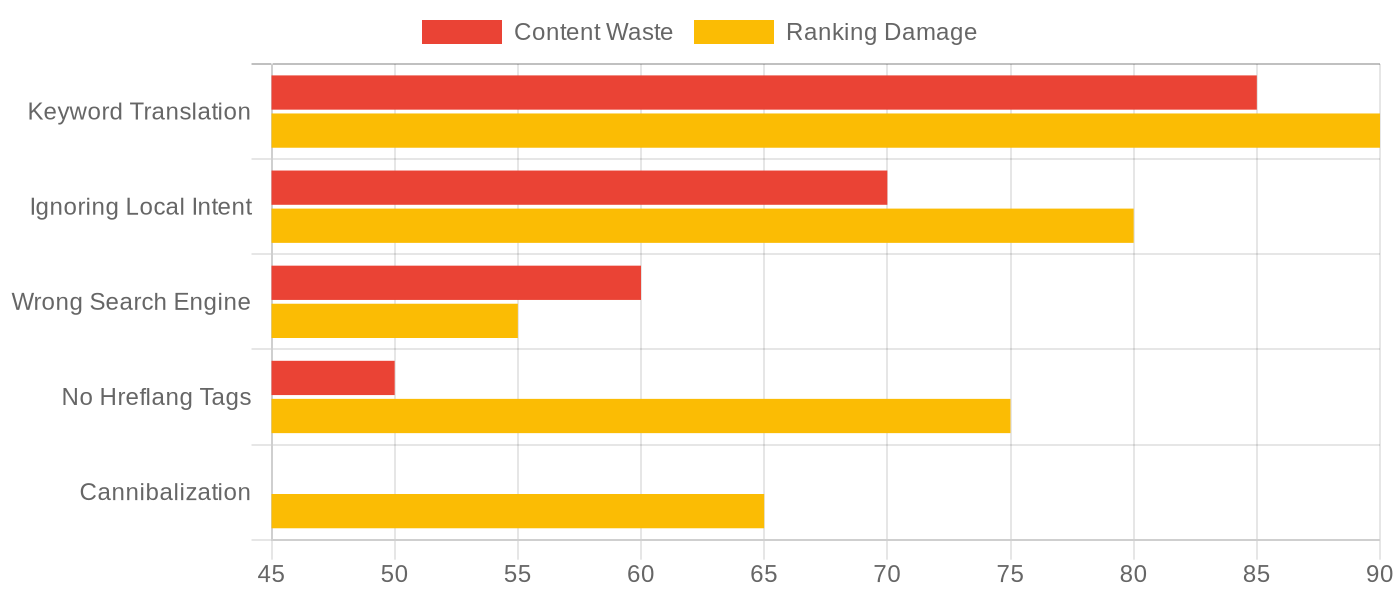
The most expensive international keyword mistakes share a root cause: treating localization as a translation problem rather than a cultural research problem. The cost compounds across content production, technical implementation, and months of missed search visibility¹.
Why Does Translation Fail as a Keyword Strategy?
Search behavior is cultural, not linguistic. A German consumer searches for “Handy” for mobile phones but also uses “Smartphone” and “Mobiltelefon” at high volumes, each with different intent profiles. No translator—human or machine—will produce the full range of relevant variants without access to local search data. Using native speakers to validate keyword lists catches gaps that translation alone creates¹.
What Happens When You Ignore Non-Google Search Engines?
Baidu’s keyword ecosystem in China operates on different ranking factors, SERP layouts, and user behavior than Google. Yandex in Russia places heavier emphasis on geographic relevance and user behavior signals. Naver in South Korea prioritizes blog and café content within its walled-garden search results. Keyword research conducted only through Google tools provides zero signal for these markets².
How Does Keyword Cannibalization Damage International SEO?
When multiple country pages target the same keyword without hreflang signals, search engines split authority between URLs and neither ranks well. A keyword-to-URL map maintained as a living document prevents this. Every keyword maps to one specific URL with correct hreflang implementation. No keyword should be targeted by multiple URLs across country versions³.
Building Your Internationale Keyword Strategy
International keyword research is the foundation that determines whether global SEO investment generates returns or runs at a loss. The process combines language, culture, and search data to make brands locally relevant in every market they enter. Relevance is contextual, and context changes by country¹.
Start with two or three priority markets. Build keyword depth and domain authority there before expanding. A concentrated approach achieving top-five rankings for 50 commercial keywords in France generates more revenue than scattered visibility across ten countries with no page-one presence. Let market response and keyword performance data guide expansion sequencing².
Ready to build an international keyword strategy that drives measurable visibility across global markets? Get in touch with HUITONGJIADA to discuss how our data-driven approach to international SEO can be tailored to your priority countries and growth stage.
1. International SEO keyword research: proven guide 2026 — masud jubayer
2. Global SEO strategy: optimizing multi-language content 2026 — click rank
3. Best keyword research tools 2026: complete guide for SEO success — topical map
4. International SEO: best practices for global SEO strategy — elite asia